Posts

Basic IT skills every teacher must have

What are the most crucial skills a teacher needs? Teaching is more than imparting knowledge. It is quite possible you will have students in your classes who know more than you.  So... how do you teach someone who knows more than you?  What skills can you teach them? Initiative Problem solving skills Research skills - to locate an answer to questions you and your students may have  Information literacy - locate the author and validity of a website Digital Citizenship - model and teach how to be safe online Able to learn, unlearn and relearn Self Discipline What does a teacher need? Must have a tool box of technology tools. Be able to use and assist students with at least one Wordprocessor Spreadsheet Presentation tool Video editing/Movie creator Picture editor Sound recorder  Video camera (maybe a phone?) Searching skills A teacher must be able to teach effective search skills. Here a few resources to help with teaching search skills. ...

Personal Interest Project Part 1

Image
Personal Interest Projects (PIP) A personal inquiry project is a research project where the topic is driven by student interest. This term I have had the pleasure of taking over a year 10 IST class. With reports and assessments completed I decided to trial a PIP with a secondary group. I will be dedicating the next few posts to how the PIP progresses in a secondary setting. The theme that was set for the term by the previous teacher is "The future of technology".  Communication All communication, links and the assignment sheets are delivered via Google Classroom. Introduction I introduced the unit by giving a guided tour of our school makerspace . It has: Oculus Rift Makerbot Digitiser Makerbot 3D Printer Makey Makey Little Bits GoldieBlox Leap Motion Chromeboxes Formatted Desktops Old computers to pull apart We watched and discussed the future of technology from the perspective of the mid 1900's through to the current day. Jetsons S...

What the MOOC? 7 things you should know.

Recently I have noticed MOOCs being discussed, more frequently, within my professional learning network (PLN). This year I heard @NatalieGoldman speak on MOOCs and I completed my first MOOC so I thought I would examine what they are, why you would use one and the benefits of them for personal development. What is a MOOC? MOOC is an acronym for Massive Open Online Course. They are often free and run with flexible completion times. To date they have been facilitated by large education groups often universities. Many offer a certificate at the conclusion.  Completion Rates The completion rate of MOOCs is quite low. Wikipedia (I know not a very good source, but easy) claims w hile many people enrol in MOOCs  only 10% of participants complete the course. EdCentral claims a 4% completion rate. This could be because of several factors. Time - MOOCs are often completed during non-work time. Many things compete for this time including family and friends. Finding dedi...

Social Learning

Image
What is social learning? This week I attended the Learn@Work conference, Learning and Development conference. The major theme was social learning. Social Learning is using the natural desire to socialise to enable learning in the work place.  Social learning is when learning occurs in a social situation. Social learning is often unstructured and an informal learning process where you receive just in time training from a colleague or you learn together how to solve a problem. Social Media may form a useful tool for social learning however it can not be forced onto learners. It is up the learner to make effective use of social media as a tool for learning. Forcing a learner to use a tool they are familiar with is not helpful in the learning process. Many people have now started to develop virtual connections using social media. Professional Learning Networks (PLNs) can enhance learning. They provide an opportunity to learn from people with different experience...

Integrators conference - Part 2

Image
AIS Integrators Conference 2014 Part 2 Time is slipping away since the AIS conference on September 16. I am trying to work through my notes and resources and post. Unfortunately I have no images for this one sorry. :-( This is the second post on the AIS conference held in September. You can read my first post here . Setting up a media team +Chris Woldhuis (@cwoldhuis) This year was asked to oversee the student council media team we have a digital display. It started off well but has not been embraced the way I would have liked.  I attended Chris' session to see what Northern Beaches Christian School has done with their media team. Chris is passionate about his media and has been making videos since he was a kid. He has found a team of like minded and very knowledgable students to be on his team.  The school has two teams, Media Team (video, photography) Production Team (sound, light and visuals) The media team has set roles for students. Head of video ...

Integrators Conference Summary 2014

Image
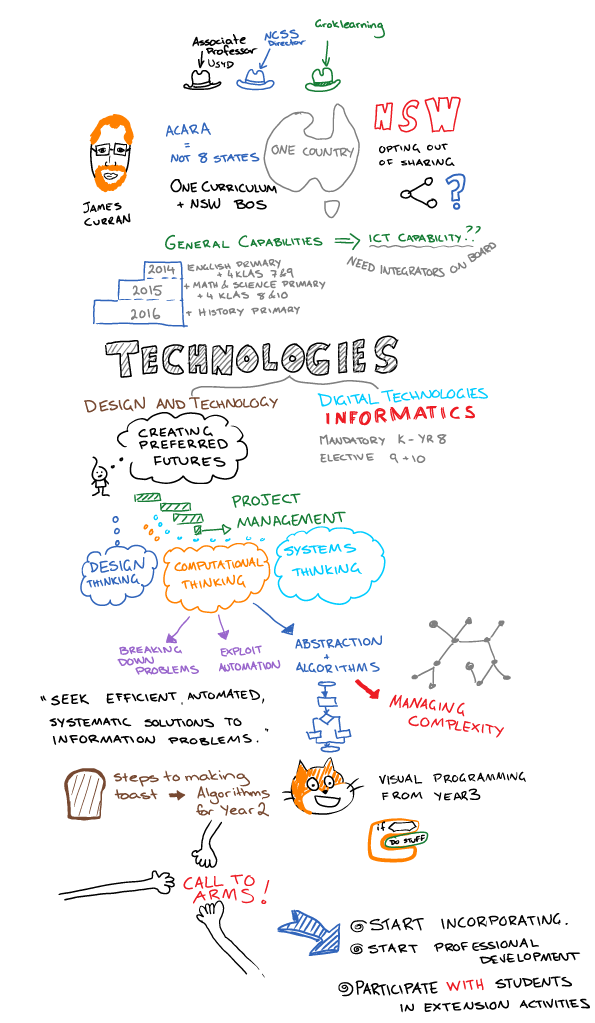
Association for Independent Schools IT Integrators Conference 2014 Two days of connecting and information information about  computational thinking,  makerspaces,  coding,  the Australian Curriculum, and  inquiry learning. Now for the hard part, to take what I have learnt and implement it. For future reference I have decided to summarise my experience of the conference. There were lots of amazing speakers unfortunately I could not attend as many as I would have liked. This is the first part of a series of posts about the conference. The Twitter feed #AISITIC14  an amazing wealth of resources, links, quotes, pics and a small amount of silliness. An AIS conference is not complete without  +Amanda Hogan   ‏ @hogesonline  sketch notes. She has graciously given me permission to use her summaries as a part of my blog. Grok Learning - James Curran  +Grok Learning   @GrokLearning What a great keynote. He spoke on the im...

What does coding teach?

Educational value of coding There has been discussion on the value of coding. Does teaching coding to Primary aged students steal valuable teaching time from literacy and maths. What does coding teach? Ultimately reading, writing and spelling skills are among the most important skills students take from education. Communication empowers people to learn and do more with their life. Skills taught in coding Coding teaches Logic - work through an order of steps Perseverance -  must solve the problem Problem solving Reading if following online tutorials Group work Coding can be used to teach Procedure writing Recounts Descriptions Information Reports Expositions Maths - 2 D shapes and angles Some of my most enthusiastic coders are average spellers and readers. One student was receiving ed support and I didn't know. Coding is a motivation to read. I have other students who are poor spellers. When typing code in HTML,  codeacademy ,  pencilcode.net ...